Sunday, 17 June 2012

Fun with Farming

Hello Internet,

Well, this blog is going to be a mixture of business and experience sharing.  Lets start with the business.

The whole overlying goal of my placement is to understand how Kuapa Kokoo operates, and also to find a some place in the process where I can insert something to make positive change for the people who matter.  The farmers! Now I have a pretty good idea of how the KK system works, and where that system could use a few small tweaks to really improve a farmer's ability to thrive.

Market Access for Alternative Crops
 During my visits with farmers a constant issue has been what the farmers do with any of their crops besides cocoa.  The system to enable a farmer to sell cocoa through the purchasing clerks is a very developed system, and ensures that if the farmers have crop to sell they will be able to get a fair price on a reasonable time frame.  Most cocoa farmers have other crops that are used to provide shade for young cocoa plants, as well as small portions of land with crops for their own food needs.  When the farmers have excess they sell it.  The current system usually involves the farmers taking the crop into town and selling the crop to middlemen who take it to the larger centers to sell - but they buy from the farmers for very cheep.  If the farmer doesn't want to sell for so cheep they don't have many other options as the shelf life for the crops is not ideal.

Now trying to combat this has proven to be a bit of an issue.  I have had a couple ideas - all hinging around grouping farmers together in order to increase their power in the market.  I think the best way to combat this would be to get farmers who have similar diversified crops to form farming groups.  Within these groups the farmers would have more options to sell their crops, such as renting a car or truck to take the load of crops into larger centers.  I have had mixed responses from farmers when I talk about this program.  Some think it is a great idea, but are unsure that their would be enough farmers harvesting at the same time to get a good enough load to bring into the bigger markets.  Another concern that I have is if the farmers do get a load together, and are able to go to the bigger markets what would they do with the crop when they are there?  Some say that they 'think' they could find a place to sell, but I have doubts.

Record Keeping of Farm Transactions and Activities
 Another big issue that I have noticed is the lack of any form of record keeping.  In every farmer group I have talked to a small selection of the farmers attended an Agriculture as a Business training course where they learned to keep records of their farming transactions and activities.  Everything from purchasing inputs (chemicals, seeds, ext)to keeping track of farm output.  Each farmer who has done this has said they benefit from keeping records.  They said it is a good way to keep track of what they did from season to season, and how that effected the output of the farm. 
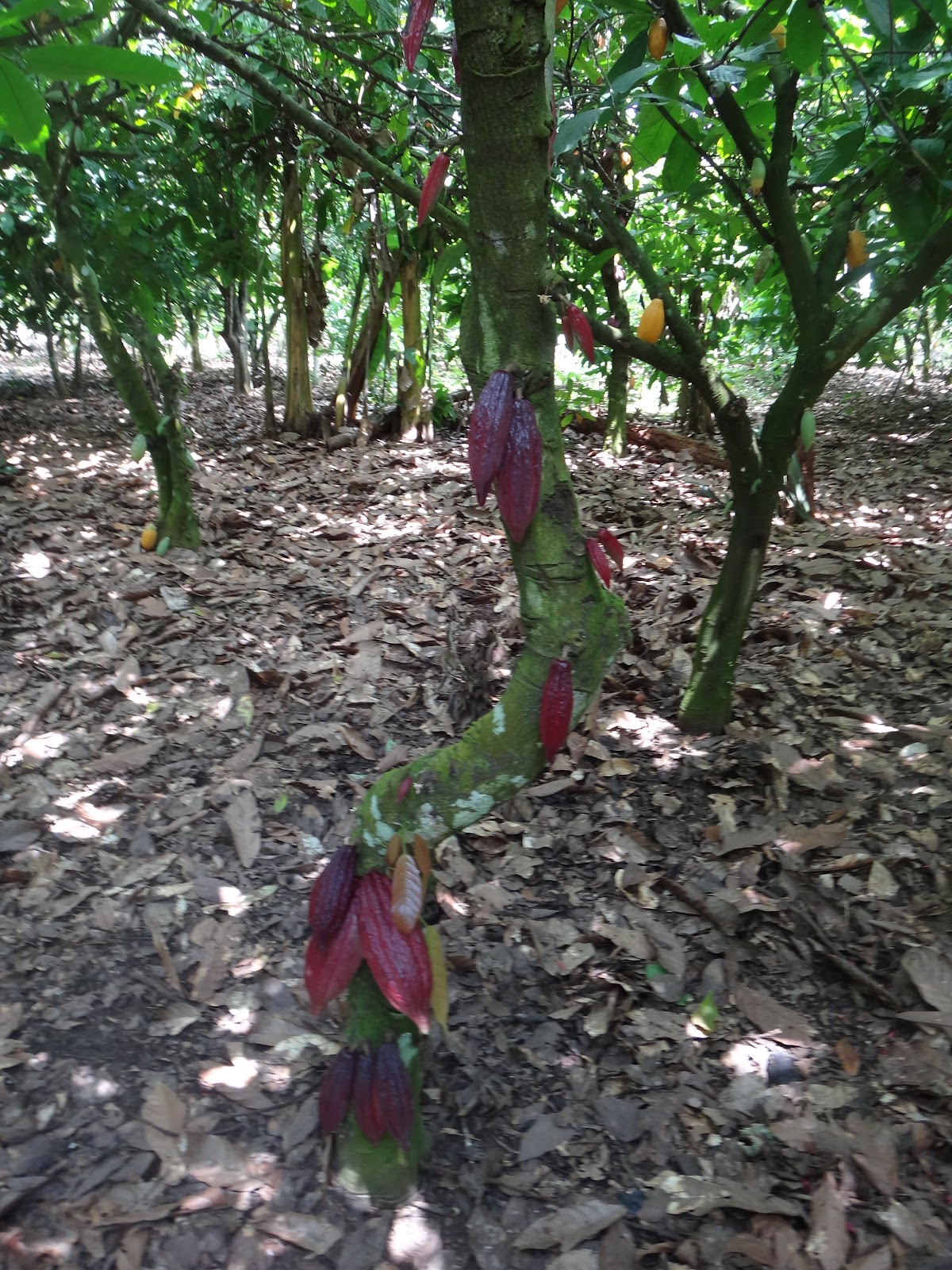
Cocoa trees - the yellow pods are ready for harvest
The big issue here is that the majority of the farmers cannot read or write.  This poses a very interesting question: How can someone who can't read or write keep records?  Now the immediate thought I had is to use the purchasing clerks as facilitators.  When the farmers take their cocoa to sell the PC can work with the farmer to fill out the form.  Now - this has it's own issues - one being that the PC already have a job to do and additional work is pretty unappealing because they have their own farms to work on as well.  The biggest issue is this:  How valuable is a piece of paper that someone cannot read?  How will a farmer benefit from record keeping if they cannot reference it themselves? 

This leads to an interesting potential solution - Visual record keeping.  Using things such as small stones, or beans in cans to keep track of things - this could be a great idea for knowing how much is owing for certain things (1 bean for every 10GhC owing for your fertilizer in the 'Ideal' milk container). 


So, those are the things I am working on - and if you know of any resources to look at, or can think of some different avenues to start looking down for solutions just email or leave a comment - help is always appreciated!

Now, onto the personal experience section!

Earlier this week I got back from my village stay.  I stayed with a local purchasing clerk and got to experience the life of a rural farmer for a short while.  I also took I think the creepiest picture will ever take in my life.

 This is a group of local children who have never seen a white man before.  I had taken a small nap because for some reason I was just exhausted. I woke up to this, and had to take a picture.

The main activities involved working in the farm, clearing some weeds in a developing cocoa patch, eating some very interesting food and meeting great people.

The most surprising thing I learned during the village stay was the different ways that farmers in Ghana acquire land.  The family that I stayed with got their land through a variation of crop sharing - kind of like a rent to own program.  If a farmer cannot work their land anymore for some reason they can find people who are willing to develop the land (Clear it, plant new cocoa trees, weed it and take care of it) The new person will work the land for eight years and get it to the point where it is producing cocoa.  At this point the land is divided into two equal sections, one belonging to the original owner and one belonging to the person who worked the land.

Now, the mysterious 'Hole of Doom'


 The HoD is known as a pit latrine.  This is one of the more interesting things I have seen in Ghana.  It utilizes the 'pop a squat' method - It isn't really the squating that got to me, it is the whole ecosystem that seams to live in the 'pit' portion of the latrine.  I have seen a variety of creature crawl out of this hole - from bats to cockroaches to mosquitoes.  It doesn't smell like roses either.  This room really made me appreciate the small luxuries I have grown accustom to - even things as 'small' as a place to sit while taking care of a daily human need.


Until next time,
Nathan

Tuesday, 12 June 2012

Pa Pa Paa!

Oh! Hello there, by the recent glorious lack of blog posts - you may have thought that something terrible has happened.  If you had thought that you would be wrong.  I have just been so busy that every night when I get home and think, "Hey, blog time!!!" I usually eat some food and then think, "Sleep time would be equally good!" and by that time all hope of a blog has flown out the window.  I apologize for my lack of communication, and reward your patience with a blog!

Now,  a quick update on what I have been up to:

I am now living in my relatively permanent home for the rest of the summer in the village of Kukuom, which is about 5km outside of Goaso.  I have settled in and am living with a family in their compound, Victoria is the name of my (awesome) host mother.  She makes sure that I will never go hungry, and with the size of the portions she serves I may never go hungry again.  Ever.  I work with a CocoaBod extension officer and have been accompanying him on his visits to the surrounding communities.  During these visits he has mainly been focusing on passing on information regarding general farm care for cocoa, as well as fielding any questions that farmers have.  After he is done I get to ask the farmers any questions I have on my mind, and then I give them a turn. 

!Challenge!
  • If any of my readers have any questions they care to ask rural farmers in Ghana, post a comment or email me!  The majority of their land is devoted to cocoa trees, but most also have plantain, maize, yams or other sustenance crops - so it doesn't just have to be about cocoa.

The Kuapa Kokoo System

I know people have been wondering how Kuapa Kokoo operates, I think I mentioned some of this in previous blogs - if I repeat myself be kind!

When I describe this system, I like to start at the farmers - they are the base of the system, and without them we wouldn't have that sugary brown drug we all know and love!

When a farmer has cocoa that is ready for harvest they cut the pods from the trees and then gather all of the pods and 'crack' them to get at the beans.  They cut into the pods with a machete and scoop out the beans along with the sugar rich pulp and pile all of the beans together on a bed of plantain leaves.  When that is all said and done they have around 100kg to 400kg of cocoa bean / pulp-y goodness that they cover with more plantain leaves and they leave it for around five days while the beans ferment.  Once the beans are all fermented (but not germinated!) they gather the beans and haul them to drying mats, spread the beans out and turn them two times a day until they are dry (from 5-8 days). 

sidenote: Drying cocoa beans is about the best smell ever.  EVER.  It is a mixture of rich-cocoa smell and a slightly perfume-y smell like that of fresh flowers. 

Once the cooca is dried the farmer takes the cocoa to a local purchasing clerk (PC) where it is loaded into 64kg bags (205GhC / bag to the farmer).  The PCs all meet every Wednesday in Goaso where they report their numbers to the district manager who will then send a truck to the PCs office to pick the cocoa and take it to warehouses.  The Cocoa Board (think wheat board) then picks the cocoa from warehouses to bring it to the port for international sale.

So, where does FairTrade come into this whole process? 

For those of you that do not know FT sets it's price for certain goods according to a 'minimum' price, where the difference between the minimum price and the market price is returned to the farmers in the form of FT premiums to be spent on social welfare projects, farmer support, or straight cash bonuses (in the case of Kuapa).  For the last number of years the market price has been above the FT price, in this case they simply attach a $150USD/tonne which is where the FT premium will come out of.  This goes to help farmers in three ways for Kuapa:
  1. A cutlas in the hand of every farmer!
Every year every Kuapa farmer receives a new machete which is used to do weeding, tree maintenance, harvesting, processing and food preparation.  I initially questioned this, but after talking to farmers it is very, very popular because they have a shelf life of about 1 year with the amount of use they see - and it is also a moral booster to see such a direct result of your work.

     2.  Money, money, money!

At the end of every year each farmer is given a bonus in the form of 2GhC / bag of cocoa they sold to Kuapa Kokoo

     3.  Schools, and clinics and wells - Oh My!

Kuapa Kokoo has a variety of social welfare projects throughout the cocoa regions of Ghana.  These are things like construction and facilitation of schools, wells and mobile medical clinics.  I have talked to a few people about these programs and have been assured that it is more than 'I see a problem, lets build something!'  solutions.  They are long term projects where support networks are set up to ensure lasting effects.

My last comment on the Kuapa Kokoo system (for now!) has to do with the strong pride and involvement the farmers have in the system.  These people are very proud to be supplying the world with the best cocoa to make the best chocolate.  If any of my friends in Ghana would like to see this in action do this, please:

  • Find a KK farmer / staffer.  Walk up to the person and proudly proclaim, "Kuapa!" in a bold voice.  The person will instantly respond, "Pa Pa Papa!" enthusiastically
SO, what just happened?  In Twi (the main language in the southern region) 'Kuapa' means 'Good Farmer' and 'Pa Pa Papa' means 'The Best'.  I have not met a Kuapa farmer that does not take great pride in their craft, and in turn is very interested in being able to increase their ability to do this.  It is a constant reminder that agency is key to my (our work).  If a person doesn't think that what they do matters - how can we improve?

Well, I have written enough for now I think - Stay tuned for another blog post later this week concerning a village and the Pit of Doom.

-Nathan


Saturday, 26 May 2012

Meetings, meetings, meetings… Featuring Food!


Hello loyal reader,

I hope everything is going great wherever you may be!

The last week has been a blur of meetings and new experiences.  I have been attending meetings with CNFA, Kuapa Kokoo, and a group of extension agents working with MoFA.  On top of all of the meetings I have had numerous opportunities to go out and experience Ghanaian culture be it looking for street food, meeting people on the street, going out to the market for various reasons, or just hanging out at the guesthouse.

In the meetings I learned a lot about how the cocoa sector works in Ghana, as well as how the government, private companies and NGOs work to support and expand this area.  The CocoBod is the governing agency that sets the price for cocoa in Ghana, as well as provides and facilitates extension work to the cocoa farmers.  Through the agents the farmers are supplied with fertilizers for the crop, as well as any other information or technology that can improve their lives, such as information about hybrid crops, problem solving for pests or disease, etc.

The work done by the Cocoa Board is supplemented by the work done by Kuapa Kokoo and CNFA.  CNFA is working on a project aiming to increase the productivity and income of cocoa farmers.  How they aim to do this is through the construction of Business Development Centers where extension staff can work out of, and having extension staff offer inputs (such as herbicides, pesticides and fungicides) in addition to the regular extension work on a pay-for-extension basis.  I do not have enough information to really go on about Kuapa yet as I have not been able to schedule a fact finding meeting yet, but I have had an introductory meeting and I should find out by Monday when the bulk of the meetings will happen.

On Friday we got to go to the Agricollage in Kumasi to talk to MoFA extension agents to ask them some questions about their jobs and the different factors that effect the extension sector.  The most surprising thing I learned during the talk was the amout of farmers that each of the agents was responsible for – between 1,000 and 2,300 per person.  This obviously presents a huge logistical problem for the agents to be able to coordinate their work, which is usually solved by grouping farmers up in their communities and having a contact farmer in each group who organizes and passes on information.  This system is less than perfect, and because of problems with transportation the agents don’t always get to visit a group of farmers for the scheduled meetings.

Now, Food.

Lets go through some meal time fun – Ghana style.  Starting with breakfast!

First you need to head down the street and make the 5 min walk to your favorite street vendor.  Then make your selection, and by selection I mean weather you would like 1 or 2 eggs in your breakfast.  So I order my usual, 2 eggs with small bread and a bag of nescafe (instant coffee).  The thing about the coffee is they put about as much milk and sugar in the bag as humanly possible – but it is still about as amazing as you can imagine.  Grab your food and then wait half an hour for the coffee to get to the point where it doesn’t quite scald you when you touch the bag and enjoy the meal!

*Blogger is sucking right now and pictures aren't uploading nice*

Now Lunch.  This one was a treat – we actually ate it pretty early in the afternoon so I wouldn’t say it was lunch in the strictest sense, but it was the biggest meal of the day so we can call it dinner and get away with it.

Went to a really nice restaurant after visiting the agricollage and had a meal fit for a king!  Banku and tilapia.  Banku is fermented corn and cassava dough cooked and pounded into a paste which is kind of sour and very tasty.  Enjoy the visual!
For supper I usually run down to a group of ladies selling street food, grab some spaghetti with rice, and egg and a quarter of a pear (aka avocado)

*Blogger is sucking right now and pictures aren't uploading nice*

Until next time!
-Nathan

Wednesday, 16 May 2012

It’s Just a Step to the Left!


It is 11:00 in the morning in Ghana, I am sitting on a bus (with air conditioning!!) heading to Tamale for my in country training.  The last 24 hours have been a bit of a blur, but I will do my best to recount every big event or cool tidbit.  Here we go!

(for added effect listen to The Time Warp from the Rocky Horror Picture Show while listening)

Toronto – 6:00PM

After rounding up all of my gear for the trip me and two other JFs set out to be the first ones at the airport (and save a little money doing it) and decided to brave the busses.  One streetcar, one subway and one city bus later we were standing at (the completely wrong side of) the terminal.  A ten minute walk later and we had handed over our bags and waited for the rest of the JFs to show up.  After clearing security and having a last drink and burger in the bar (tequila shot chased with some Heineken … I enjoyed one of those things) we were on the plane and on our way to Amsterdam!

Amsterdam – 12:00PM

Well, having just landed and gotten off the plane we decided to find our new gate.  After finding the gate may people (not me, apparently Sasktel doesn’t really care if you know) got texts from their service providers summarizing to:

Texts : $0.75
Calls  : $2.00/min
Data  : $0.03/kb

For those of you who don’t know, that would mean downloading a movie (usually 700mb) would result in a $21,500 phone bill.  I immediately turned my phone on airplane mode and have had it that way ever since.  After a wonderful impromptu piano recital from Ryan (Nocturne in B flat minor) we all cleared security and got aboard the flight. 

            When I took my seat in the plane I was informed (in Dutch) by a police officer that there would be two people being deported on the flight, and that one of them was quite upset and would likely be screaming.  I then told him I didn’t understand a word he said, and repeated it in English.  At the time of the warning I didn’t think much of this, I have heard people scream before, and I have seen people upset before.  

I was wrong.  The man was quite large, and did not want to be on the plane, his screams rang through the plane until we had taken off, and were then replaced momentarily by weeping, and then silence.  He was screaming as if he was being taken to his death.  I wish I knew more of his story.

Accra – 8:00PM

Well, we all got off the airplane and hit ‘the wall’, the wall of humidity that is.  The heat wasn’t bad – 26 Celsius, and the sun had been down for around an hour or two.  Getting into the terminal and flashing my yellow fever immunization card got me into the immigration lines.  An hour and a half later we had gotten all our bags and met the APS who would be taking care of us for the next little while.  A short taxi ride later to the guest house and I was setting up my mosquito net in hopes of a bite free night.  The place was very nice – an outlet to charge my computer and even a shower, only one temperature – cold.  It was bliss.


Well, that pretty much brings us to today, we woke early – got the bus terminal at around 5:30 so we could take the 6:00 bus to Tamale.  Two and a half hours later the bus showed up and we were on our way.  The first rest stop let me pay 0.20 Cedi to use the washroom, and then I got a meat pie (the friggen best ever!)  and some very fresh and very wonderful mango for dessert.  

The next day we did some cool team training stuff, then went to the market to buy an assortment of supplies.  We got phones, passport pictures, and many other things - including my very first 'Star' beer (a Ghanian beer) which was very good.  Still don't have internet though - I need to get an MTN data stick, which I am not very sure when I will get - but they are around 60 Cedis for 4 gigs of 3G data (around $10 a gig, which seems fairly inline with Canadian prices)  

Anyways, I should stop stealing another JF's data stick for tonight (Thanks Cecile!!)

Until next time!
-Nathan

Tuesday, 8 May 2012

Predep Madness

Here are some random pictures with a post to come in the edits!!


Saturday, 5 May 2012

Toronto Time!!

 First of all I would like to send a very big thank you to everyone who wrote me letters to open throughout the summer.  I have already gotten to open a couple, and am really looking forward to reading them!

Well, It has been a long time coming - but I finally made it to Toronto for predeparture training (predep).  Predep is the time where the JFs who are going to the same country get together for some group based learning and team building covering everything from in country safety to communication styles.  These sessions are going to be giving me very valuable information that will help ensure that my placement is successful.

Speaking of placements.... My placement is with the AgEx team (as previously mentioned) working with a company called Kuapa Kokoo through CNFA.  CNFA is an American organization which is 'dedicated to stimulating economic growth around the world by nurturing entrepreneurship, private enterprise and market linkages.'  CNFA has a project in Ghana where they are trying to increase the income of cocoa farmers by increasing the quality of the product as well as expanding production.  This is where the placement ties into Kuapa Kooko.  Kuapa Kooko is a farming cooperative formed in 1993 by a group of farmers in Ghana and through the years has gained Fairtrade Certification and has grown to a membership of over 45,000 producers.  Kuapa Kooko improves the livelihoods of the farmers through projects such as building several schools, organizing mobile clinic visits to communities, as well as investing in equipment and training farmers can use to break into other channels of income.

Now, what am I going to be doing, you ask?

Well, it is sort of split into two different main task groups:

1) For Kuapa Kokoo
-One of the main issues with extension services is that you cannot force a person to accept the technology or education that you are distributing.  One of my tasks is to identify and prototype a solution to some of these barriers blocking the acceptance and use of technology and changing farmer behavior towards extension attempts.
 -The farming population as well as the cocoa trees themselves in Ghana are aging.  This has been identified as a potential cause for a loss in the quality of the cocoa being produced, and less income for the farmers.  Crop diversification would help to offset this loss, as well as reduce the economic hit from potential environmental factors that could reduce the price of a cocoa crop.

2) For EWB
-The AgEx team is interested in looking at how Kuapa Kokoo and CNFA go about agricultural extension and want a breakdown of their model.  What services does Kuapa Kokoo offer to farmers?  How is this presented to farmers? How do farmers and extension agents communicate? and many other questions need answering in order to fully understand the process.  The long term goal of this is to gather the best extension techniques for varying situations and find out how viable private sector extension agencies can be.

Now, I think that is enough from me for a little bit - Now I want something from YOU!


In the comments bellow I would like people to think of different questions for me to answer about Kuapa Kokoo's extension practices.


------------------------------------------------------------------------------------------------
Links for further reading:

CNFA - http://www.cnfa.org/
Kuapa Kokoo - http://www.kuapakokoo.com/index.php
Fairtrade - http://www.fairtrade.net/


Thursday, 5 April 2012

African Adventure Update

Hey everyone who might read this (that's right, all five of you!),

I haven't blogged for a really long time about my terrific trip of another T word, so I decided to give you all a little update. 

First off - I have so many little snippets of blogs-to-be that I wrote and decided that they weren't exactly blog worthy, so I decided I am going to post them throughout the summer as footers for my blog posts overseas.  I am dreaming that I will be able to mash up the posts in a way that ties the two together - be it a solution to a question I was thinking about that particular day, or just a general brainstorm about different ideas I had. So that could be cool, but it could also fail miserably - time will tell!

Now - On to the actual meat and potatoes of the experience.

Important Update Numero Uno:  I am going to Ghana.  It was decided a few weeks ago that I am on the AgEx team (Agricultural Extension for those of you who hate abrev.). This seems really awesome, and was my first choice in teams - so I am pretty well all around stoked.

Important Update Number Poo: I get to send an email tonight explaining what specific team I want to work with, and why I would be awesome.  This is pretty cool, and pretty damned nerve racking - so I hope I am able to piece something together in between supper and food coma o'clock.  I don't want to go too in depth at the moment because I am really hungry and have a gift certificate to a buffet (score!) - but the two teams I am interested in are:
Short Agribusiness Farmer Training Opportunities, which is a program about knowledge spread and developing short courses about agribusiness through working with the Ministry of Food and Agriculture as well as the Farming Institutions.

Kuapa Kokoo,  this is a Fair Trade Certified cocoa company that operates as a co-op.  I would be assisting in the day to day operations of the company through interaction with farmers as well as extension staffers, as well as examining the company looking at the success and failures of certain programs.  The idea here is to look at the third party company and how they operate, compare that with what we know are already good extension techniques and practices and find the best way for the company to operate.  I am most excited for this one (crosses fingers / knocks on wood and all that jazz)

OH YAH, update on my dates - I go to Toronto on May 5th and get back from Africa on August 27th.

Anywhosits,

I leave you with one request: If you feel comfortable, I ask you to write me a letter.  This can be about anything you would like - serious, funny, random, or inspiring. Just write the letter, seal the letter - and leave me instructions on what date, or what time, or during what event / feeling you would like me to read it.  Thank you very much to those who have already done this, and thank you for considering it.

'till next time,
-Nathan